

A Big Bold Beautiful Journey

I went into A Big Bold Beautiful Journey (2025), recently made available on Netflix, with absolutely no sense of the storyline. Sometimes that’s the best way to encounter a film. With no expectations to manage and no trailer logic to undo, you’re free to simply watch and see what happens. What I found was a fantasy-based romantic comedy that takes itself rather seriously at times, moves at its own pace, and ends up having more to say than I expected. I recommend it.
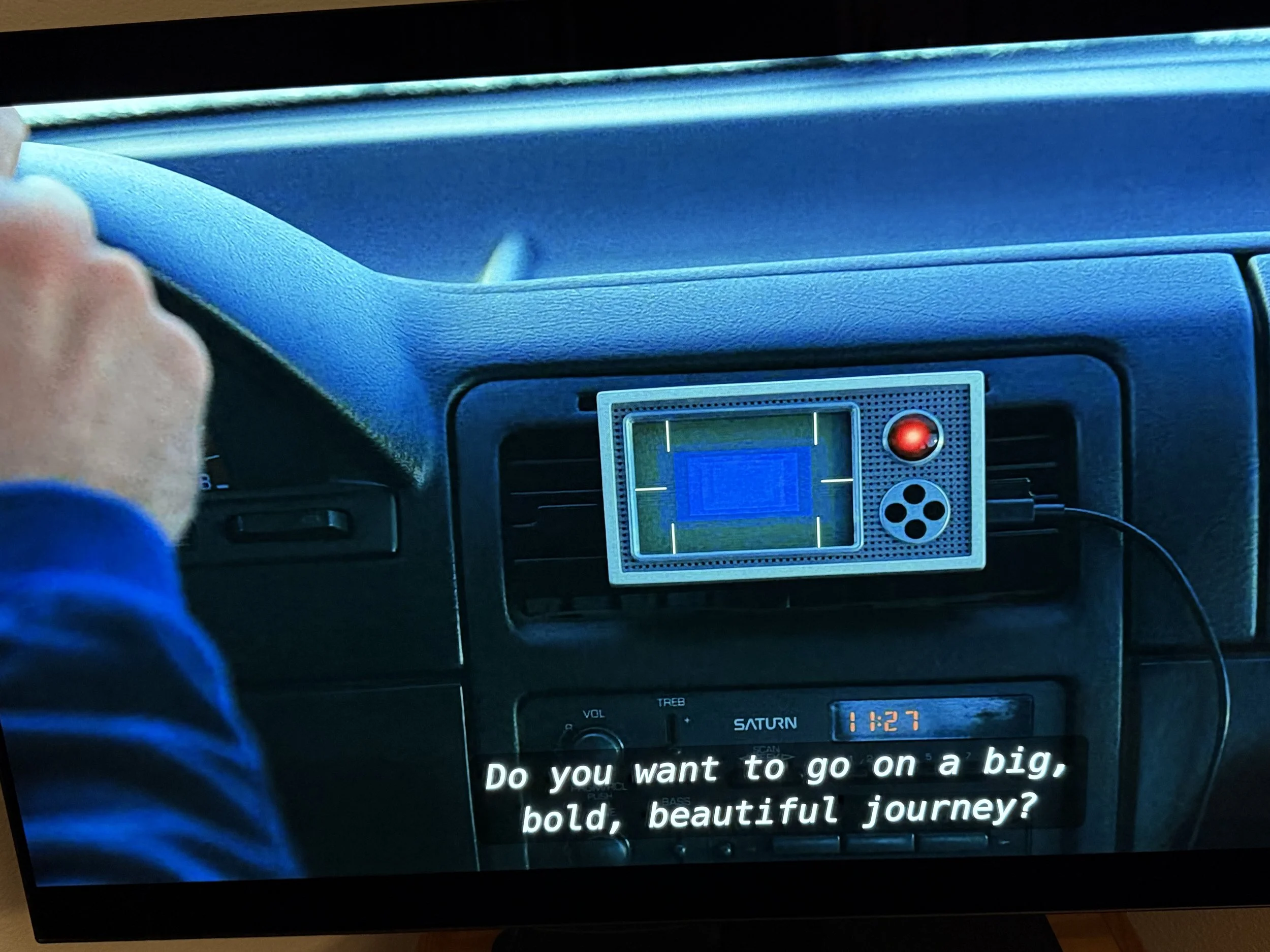
The film opens at a generically named “Car Rental Agency,” where David (Colin Farrell) encounters two unusually quirky employees, Kevin Kline as the Mechanic and Phoebe Waller-Bridge as the Cashier. David is on his way to a friend’s wedding. The car he rents, a 1994 Saturn SL, comes equipped with a GPS unit that quickly establishes itself as a character in the story.
At the wedding, David locks eyes with Sarah (Margot Robbie), and the two engage in flirtatious, slightly offbeat banter at the reception. At one point, Sarah semi-seriously asks David to marry her, a moment that clearly unsettles him. What is he to make of this unconventional woman? When Sarah then asks him to dance, he declines. Later, she leaves with another man.
Driving home, the GPS asks David if he’d like to go on a big, bold, beautiful journey. He agrees, and with that, the film’s fantasy premise is underway. David is soon instructed to take the next exit and order a fast-food cheeseburger. Inside the restaurant, he discovers Sarah, also eating a cheeseburger. When they leave, Sarah’s car, another Saturn from the same rental company, refuses to start, and David’s GPS instructs him to offer her a ride. She accepts, and the two begin sharing the rest of the drive home.
From there, the film settles into its central rhythm. The GPS directs David and Sarah to a series of roadside stops that turn out to be doors, both literal and metaphorical. Behind each door lies not so much a place as a moment in time. These episodes are drawn from the characters’ pasts, and what’s striking is how matter-of-factly they accept what’s happening. There is only a modicum of astonishment. David and Sarah step into these moments as if the past were still physically present, waiting to be revisited.
One door, for example, takes them to David’s high school on the night he is starring in the class musical, How to Succeed in Business Without Really Trying. He plays the lead role of J. Pierrepont Finch, with Sarah and his parents watching from the audience. During the show, David relives a painful romantic rejection, confessing his feelings to a costar offstage and then, in an impulsive moment, temporarily derailing the production by confronting her onstage with blunt observations about the life she will go on to lead.
In a later scene, they stop at a decaying roadside billboard with an opening that leads into a café. Inside, two conversations unfold at once. David’s former fiancée presses him for an explanation about the end of their engagement, while Sarah revisits the collapse of a relationship with a former boyfriend. Eventually, the two conversations merge, with all four characters seated at the same table. David and Sarah are given an unusually revealing view of how each has behaved in earlier relationships, and both are forced to acknowledge their own intimacy issues.
By this point, it’s very clear that this big, bold, beautiful journey is less about time travel than about self-examination. As David and Sarah move through these episodes together, the focus remains on how they respond to what they learn about one another. They watch. They ask important questions. They engage in remarkable amounts of self-disclosure. The film allows these moments to unfold slowly. The pace worked for me, though I can see why others might find it trying. This is not a movie in a hurry.
What the film seems most interested in is not whether David and Sarah will end up together, but what it means for two people to really see one another. By the time you’ve lived a while, introductions are never clean. Everyone arrives with baggage, earlier versions of themselves still visible around the edges. A Big Bold Beautiful Journey makes that idea concrete, and in doing so, captures something emotionally recognizable.
I was willing to go along with the unlikely premise and the deliberate pacing largely because the performances are so grounded. The connection between Farrell and Robbie builds through pauses, glances, shared silences and, often, moments of unusually deep honesty. That connection feels earned, not manufactured.

What stayed with me afterward was not a particular scene or line of dialogue, but the film’s underlying suggestion that not every meaningful encounter has to resolve into something permanent. Some meetings matter because they clarify where you are, or because they briefly align two lives that have been moving along separate tracks. That idea resonated with me more than any conventional romantic payoff might have.
Not everyone will be taken with this film. It asks for patience and a tolerance for ambiguity. It treats human connection as something provisional and fragile, shaped by timing and circumstance, and often understood only in retrospect.
By the end, A Big Bold Beautiful Journey felt less like a romance than a meditation on how lives intersect, diverge, and occasionally overlap just long enough to matter. For me, that made the journey worth taking.
Recent Column Ignored Deeper College Issues
This is the unabridged version of the Guest Column I published in the Lookout Eugene-Springfield, December 2, 2025
After reading John Anderson’s recent essay in Lookout (November 26), I felt compelled to respond. His column closely resembled an email he circulated to various campus groups in November and, taken together, they present a very narrow picture of conditions at Lane Community College. His focus is almost entirely on the tone of criticism at Board meetings and on the affiliations of certain trustees. These concerns have their place, for sure, but they do not explain the deeper issues the college has been confronting for more than a year. Any serious discussion of what’s happening on campus needs to acknowledge the broader context.

What stands out in Anderson’s commentary is what it leaves unaddressed. Instead of focusing on the content of long-standing concerns, he chooses to discuss how various issues have been voiced. Tone matters, of course, but I’m fairly certain that that’s not the central issue. People speak passionately when they feel their questions are not being taken seriously, when planning is unclear, or when major decisions lack transparency. I attended the November 5 Board meeting he refers to and found the audience demeanor almost entirely civil and restrained. To the extent frustration was visible, I believe it reflected months of extreme stress within a campus environment that many employees now describe as increasingly perilous to navigate.
These issues are not abstract. After my most recent Eugene Weekly essay about LCC, a faculty member wrote me to say that many colleagues avoid speaking at Board meetings or attending union activities because they fear retaliation. They described low morale, the real possibility of a strike, and a sense that a no-confidence vote may be the only meaningful avenue left to express collective concern. For part-time faculty, job insecurity makes this climate even more stressful. This account is not unique. It echoes what many have been saying quietly for months and reflects a pattern that Anderson’s framing does not account for.
It is also inaccurate to suggest, as Anderson does, that criticism of the administration comes from only one constituency. Qualms about college governance, communication, and major decisions have surfaced repeatedly from many corners of the institution, including students. Some of these concerns are public; many are not. Over time, the pattern has become unmistakable. Anderson’s column instead mirrors the position consistently taken by the three-member Board minority who have resisted a fuller examination of administrative choices and their impact on students and staff.
Selective accomplishments, such as enrollment growth, cannot substitute for transparency or sound processes. In three Eugene Weekly columns this year, I have written about broader institutional concerns involving governance and decision-making practices. Program decisions have played a part in that story, especially where course offerings and academic pathways have been affected. During my years as an academic dean, I came to understand how essential predictability and clear communication are when building schedules and supporting programs. When course sections are reduced or altered without strong planning and transparency, the effects ripple quickly into impaired student progress, increased faculty workload, and departmental instability. These are not theoretical issues. They directly affect the community the college is meant to serve.

Anderson also argues that the Board is engaging in micromanagement. That characterization does not match the facts. Boards should not run day-to-day operations, but they are responsible for oversight when policy, academic direction, and institutional mission are involved. Trustees who ask for clarity or request information are not overreaching; they are fulfilling the responsibilities the public entrusted to them. When those requests do not appear on agendas or when major decisions proceed without Board involvement, the issue is not interference. It is a restriction of the Board’s proper role at a time when oversight is especially needed.
His reliance on charges about the faculty union, raised by the NAACP, also requires further context. Those concerns matter and deserve serious attention. But they do not address the substantive questions that faculty, staff, and community members (including myself) have been raising for more than a year. The criticism being voiced is about decisions, communication, planning, campus climate and leadership approach. It is not about the president’s identity. These issues require direct engagement, not dismissal.
Finally, here’s what I believe: Anderson’s focus on tone offers a convenient way to avoid the substantive issues the college must address. What LCC needs now is presidential leadership willing to directly engage the challenges before us, and a Board committed to ensuring that such leadership is fully and responsibly exercised. That combination of leadership and oversight is what will allow the college to move beyond its current difficulties and fulfill its mission to students and the region it serves.
No Confidence
This is the op-ed I published in the Eugene Weekly, November 26, 2025
Last spring (EW, April 16) I wrote that the Lane Community CollegeBoard of Education had become dysfunctional and needed new voices. When I followed up just recently (EW, October 9), I had hoped to report progress. I couldn’t. The same divisiveness remains and the stakes have only grown.
It now seems apparent that LCC’s problems go far beyond a Board unable to find itself. At the November 5 Board meeting, over two hours of public comment revealed deeper layers of concern. Speakers described an administration that, in their view, operates with limited transparency and contributes to a culture in which employees hesitate to speak openly. Several also stated that a divided Board has not provided the oversight the college requires.

President Stephanie Bulger’s leadership has strained relationships with faculty, staff, and some trustees. Rather than collaboration, many describe unilateral decision-making and limited inclusion in governance. One of the president’s stated goals early in her tenure was to improve campus climate. Multiple accounts now indicate that this has not happened. Instead, trust has deteriorated and the fear factor has increased.
Faculty union president Adrienne Mitchell’s open letter to the Board (posted to lccea.org on November 4) courageously documents many of these issues. She reports that employees have been pressured to resign or sign nondisclosure agreements and that faculty and administrators are afraid of retaliation for speaking up. After raising concerns, she was reportedly told by the president, “I don’t know how long you’ll be around here,” before facing a proposed layoff.
Her letter also highlights damaging operational decisions. The suspension of the Licensed Practical Nursing program last spring, enacted without public input or a Board vote, left thirty-seven qualified applicants without a viable local training path. Meanwhile, delays in promoting the new Bachelor of Science in Nursing program resulted in only eleven students enrolling instead of sixty.

As a former academic dean responsible for scheduling, I know course planning must be dependable and student-centered. Yet, this fall, more than 100 course sections were canceled, including core classes with active registration. Late cancellations derail student progress and weaken confidence in the institution. Faculty estimate tuition losses may reach $1 million. These reductions appear inconsistent with the adopted budget and limit student access.
Labor negotiations have also deteriorated. Talks are nearing impasse. According to the latest faculty-union bargaining update, there has been no substantive movement from the administration on compensation, benefits, workload, or job security. The administration’s cost analysis has been strongly disputed by faculty. With only two sessions remaining, mediation appears likely. While strike action is not imminent, some faculty have begun considering it as a last-resort option should conditions fail to improve. The central issue right now is the absence of meaningful progress.
Concerns extend to Board governance. For example, when several trustees requested an agenda item reaffirming Board authority over program and service reductions, it did not appear. Instead, an administrative memo supporting the president’s position was included. This outcome limited the Board’s ability to fulfill its duty to oversee operations at a critical time. In my October 9 column, I suggested that Trustee Mulholland step aside to demonstrate Board accountability. With the fuller scope of concerns now evident, it is clear governance issues extend beyond any one trustee. The problem lies with a governing body that has not acted decisively while the institution struggles.
Given the continuing lack of trust, the deteriorating labor posture, the failure to improve campus climate as promised, and the absence of collaborative leadership at a time when stability is essential, I see no viable path forward under current conditions. I recommend that the Board decline to renew President Bulger’s contract and begin an open, transparent leadership search grounded in accountability and partnership. This is not a punitive decision. It is responsible stewardship on behalf of the institution.
If the Board does not act unilaterally, I suggest that faculty consider a formal vote of No Confidence to publicly affirm that administrative leadership marked by fear and stalemate cannot continue.
Lane Community College remains one of Lane County’s greatest public assets. It educates our workforce, expands opportunity, and strengthens the local economy. At this critical moment, leadership must demonstrate the courage to act. The community is watching. The future of the college depends on it.
An Embarrassment to Our Community
This is the op-ed I published in the Eugene Weekly, October 9, 2025
Last spring, in these pages (EW, April 17), I suggested that the Lane Community College (LCC) Board of Education might resolve its dysfunction by electing some new members. Six months later, I’ll admit that my optimism was misplaced. While we now have a couple of new faces, the Board remains divided, unproductive and, at times, an embarrassment to our community.

Several others have also recently weighed in on the College's status. First, former faculty member Steve McQuiddy (EW, September 4) reminded us that the institution once thrived on trust, cooperation, and a commitment to the collective good. Then, College President Stephanie Bulger (EW, September 11) and Faculty Union President Adrienne Mitchell (EW, September 25) both described LCC as being at an “inflection point,” though they disagreed on what that might mean. Bulger argued that “expenses have risen faster than revenue” and announced annual budget reductions of $3 million through 2029. Mitchell countered that reserves have “increased by $1 million over the last two years while revenue exceeded expenses, not the other way around,” and that the administration has sidelined both the Board and public, pointing to the unilateral pause of the Licensed Practical Nurse (LPN) program.
But let’s back up. I contend the cracks in Board governance first became public when the body failed to fill the vacancy left by Trustee Lisa Fragala’s resignation late last year. Four qualified applicants stepped forward, but the Board deadlocked and left the seat empty — an early sign of its inability to act decisively.
More troubling conflict soon followed. In early April 2025, then-Vice Chair Kevin Alltucker read a letter into the record accusing then-Chair Zach Mulholland of abusive and bullying behavior toward President Bulger. The College commissioned an independent investigation, which in late June substantiated the complaints. The report found Mulholland verbally abusive, hostile, and intimidating toward Bulger, as well as a student, while also noting broader dysfunction within the rest of the Board.
The community responded swiftly. At the September 3 Board meeting, more than two dozen citizens, including two former LCC presidents and a former trustee, spoke with one voice: Mulholland had lost the confidence of the public and should resign. Instead, the Board voted to censure him. Now, while serious in theory, censure is largely symbolic. It leaves the censured member in office with credibility unaddressed.

Meanwhile, the Board has stumbled in other areas of its responsibility. This fall, trustees have struggled to define their role in decisions about academic programs. The temporary suspension of the LPN program, implemented by the administration without a formal Board vote, illustrates this challenge. The Board’s discussions sparked by this move have been disorganized, poorly informed, contentious and often disrespectful. Then, at the September 30 meeting, the President’s goals, up for official approval, included those annual $3 million budget cuts mentioned above. During the public comment portion of the meeting, it had been suggested that this Presidential goal circumnavigated the prescribed institutional budget-development process, so during consideration of this item there were exchanges that clearly illustrated the divisions within the Board — as well as the power struggle between the Board and the President.Taken together, these issues are examples of the dangers discussed by Mitchell, because when transparency and shared governance are sidelined, students, faculty and the College’s mission are put at risk.
McQuiddy’s reflections provide a constructive contrast. Faculty and staff have long prioritized collective success over personal gain, demonstrating trust, collaboration, and commitment to the broader community. If the Board emulated such an ethos, it could rebuild confidence and make decisions rooted in LCC’s shared mission.
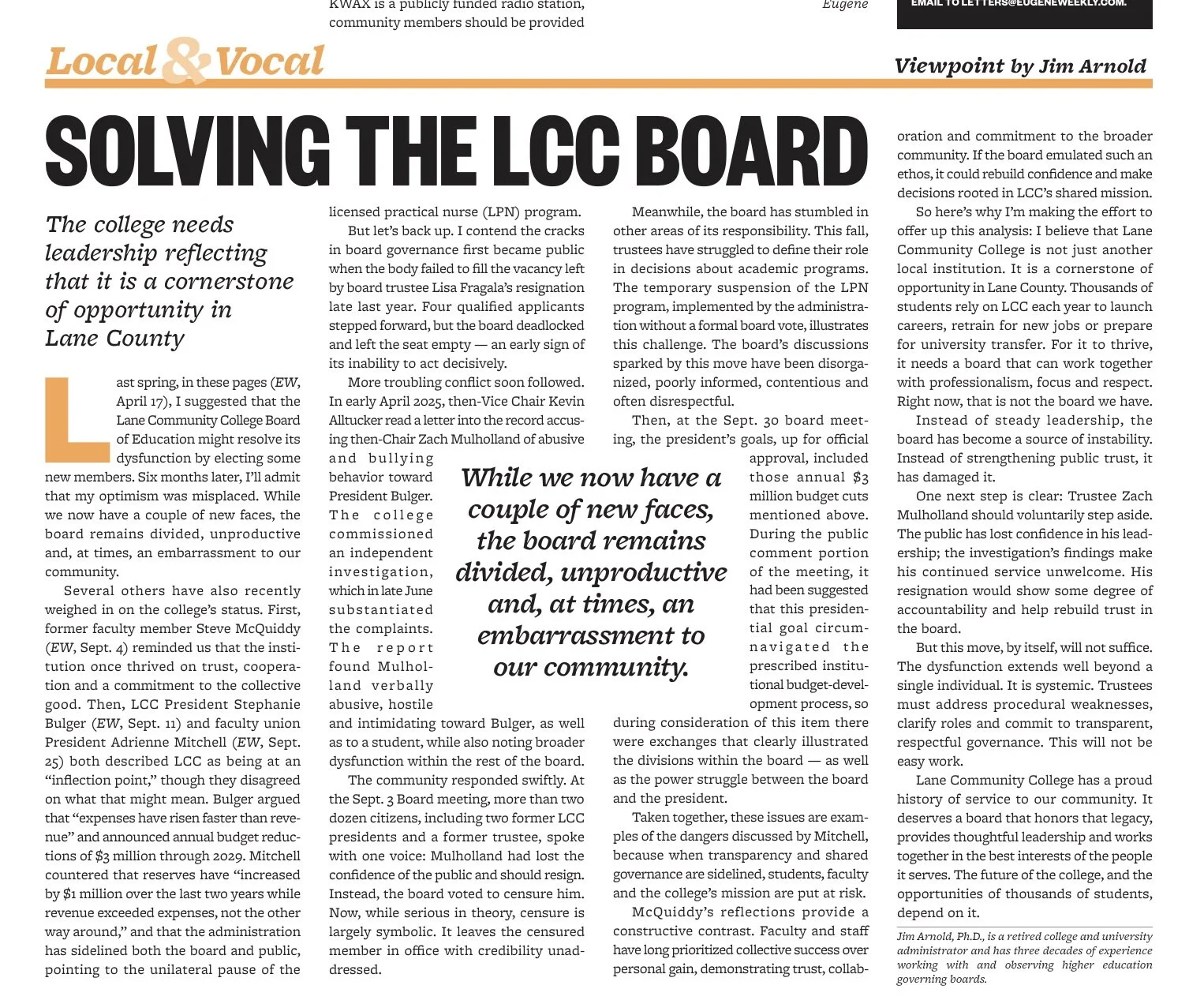
So here’s why I’m making the effort to offer up this analysis: I believe that Lane Community College is not just another local institution. It is a cornerstone of opportunity in Lane County. Thousands of students rely on LCC each year to launch careers, retrain for new jobs, or prepare for university transfer. For it to thrive, it needs a Board that can work together with professionalism, focus, and respect. Right now, that is not the Board we have.
Instead of steady leadership, the Board has become a source of instability. Instead of strengthening public trust, it has damaged it.
One next step is clear: Trustee Zach Mulholland should voluntarily step aside. The public has lost confidence in his leadership; the investigation’s findings make his continued service unwelcome. His resignation would show some degree of accountability and help rebuild trust in the Board.
But this move, by itself, will not suffice. The dysfunction extends well beyond a single individual. It is systemic. Trustees must address procedural weaknesses, clarify roles, and commit to transparent, respectful governance. This will not be easy work.
Lane Community College has a proud history of service to our community. It deserves a Board that honors that legacy, provides thoughtful leadership, and works together in the best interests of the people it serves. The future of the College, and the opportunities of thousands of students, depend on it.
Sardines in the Back Bar: My High School Reunion
I graduated from high school in 1965, right in the middle of that turbulent, unforgettable decade. Last month, I made the cross-country trek from Eugene, Oregon to Rice Lake, Wisconsin for my 60-year reunion.

Traveling to rural northern Wisconsin isn’t easy. These days, I take two days just to get there. This time I flew to Minneapolis via Seattle, rented a car, and drove to a nearby hotel in the dark. Car rentals, of course, come with their own set of challenges. I drive a 2020 Subaru Crosstrek at home, so when I found myself behind the wheel of a 2025 Nissan Rogue, I had to pause in the airport lot, dig out the 600-page manual, and acquaint myself with the vehicle’s basics. Eventually, I made it to the airport Holiday Inn Express, tired but in one piece.
Day two was the drive to Rice Lake. I stopped in Menomonie to see my friend “BA,” a classmate I’ve known since I was 12. We’ve been in steady contact — often over Zoom during and since the pandemic — so our conversation flowed easily, even if it wasn’t about anything in particular. Politics and religion are off-limits between us, so our chatter resembled a Seinfeld-style “conversation about nothing.” Still, it was grounding to reconnect before the busy weekend ahead.
On day three, I had breakfast with another classmate, “CJ.” We first reconnected at our 40th reunion and in recent times have grown a bit closer through regular Zoom calls. Our conversations are different from most — personal, probing, unafraid of difficult topics like family dynamics, belonging, and the choices that shaped our lives. Sitting across from her in person gave those exchanges a richness I rarely find elsewhere.
That evening was the first group gathering at a local pizza place. I had gone in with low expectations, and still, the chaotic setup surprised me: thirty or so people crammed into the back corner of a bar with no clear plan for how to mingle or sit together. Consequently, BA and I retreated to a booth for dinner before cautiously rejoining the group once the crowd thinned. To my relief, I found a few familiar faces and even received a warm hug from a female classmate who had been reading my writings over the years. Those small moments of recognition helped balance out the initial frustration.
The next morning, BA and I met again for breakfast, this time joined by “WJ.” Our conversation took a surprising turn when, at one point, he asked, “Do you believe in vaccines?” The question startled me, but to my relief, all three of us agreed. Still, it was a reminder of the cultural divide I often feel when I return to Rice Lake — a blue-leaning visitor navigating a visit to a deeply red part of the country.
Saturday night was the main event at Lehman’s Supper Club, the classic Rice Lake venue for special occasions. Drinks started at five, but I stuck with ginger ale while classmates sipped their cocktails. I chatted briefly with a few people, but the connections felt fleeting. Dinner was buffet-style, serviceable but unremarkable, and I found myself at a table where conversation was scarce. By 7:30, much of the room had emptied out.
